AI and Succession Planning: From Static Plans to Living Portfolios
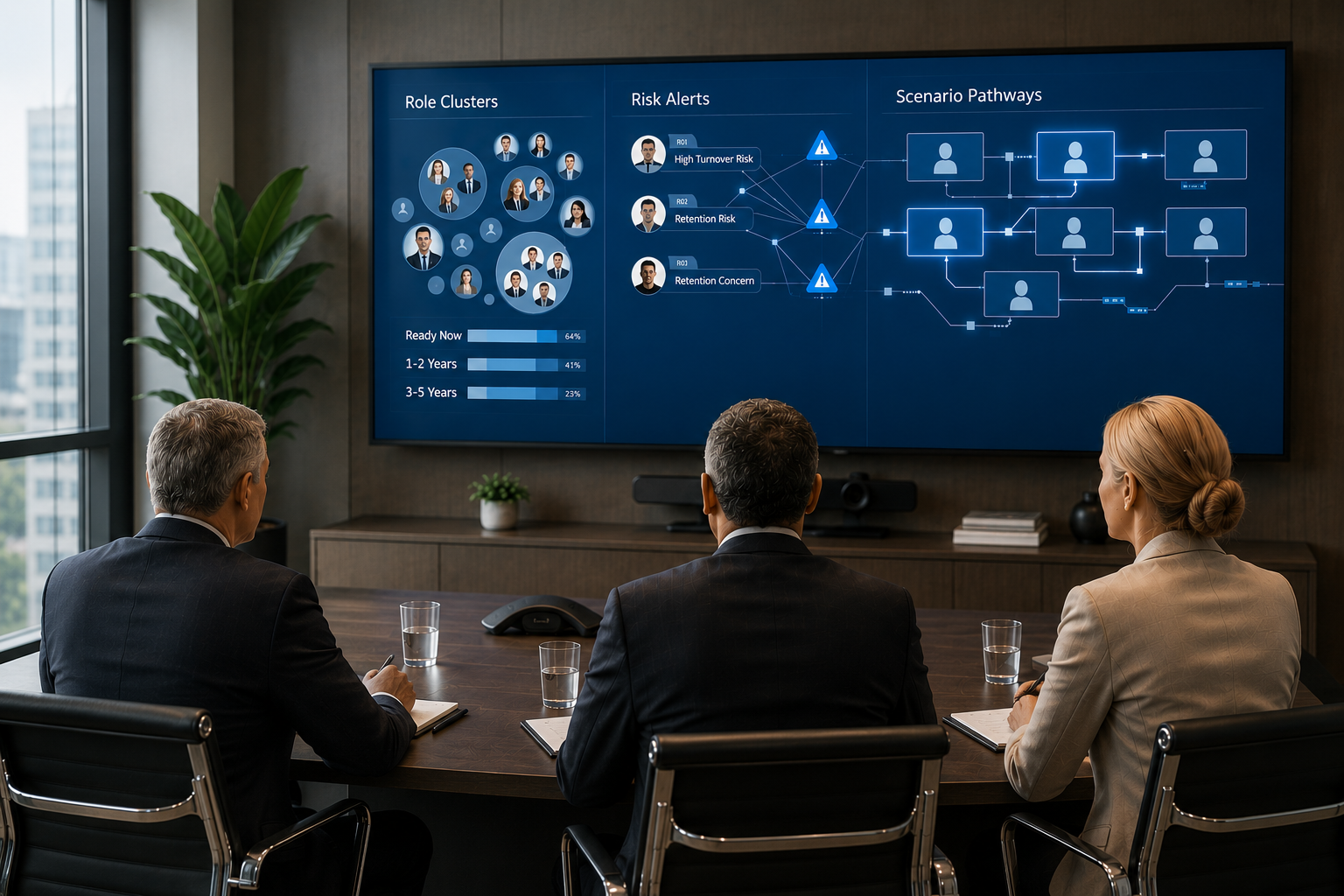
Most succession plans become stale before they are used
The familiar pattern is easy to recognize. A small group meets. Critical roles are listed. A few likely successors are discussed. A slide deck gets refined, color-coded, and approved. Then the business changes. A reorganization happens. A key person resigns. A market shifts. A role quietly changes shape. One 'ready in 12 months' candidate takes an international move, another burns out, and a third becomes more valuable in a different role than the one the plan had in mind.
None of that means succession planning is less important. It means the static, list-centered version is no longer sufficient.
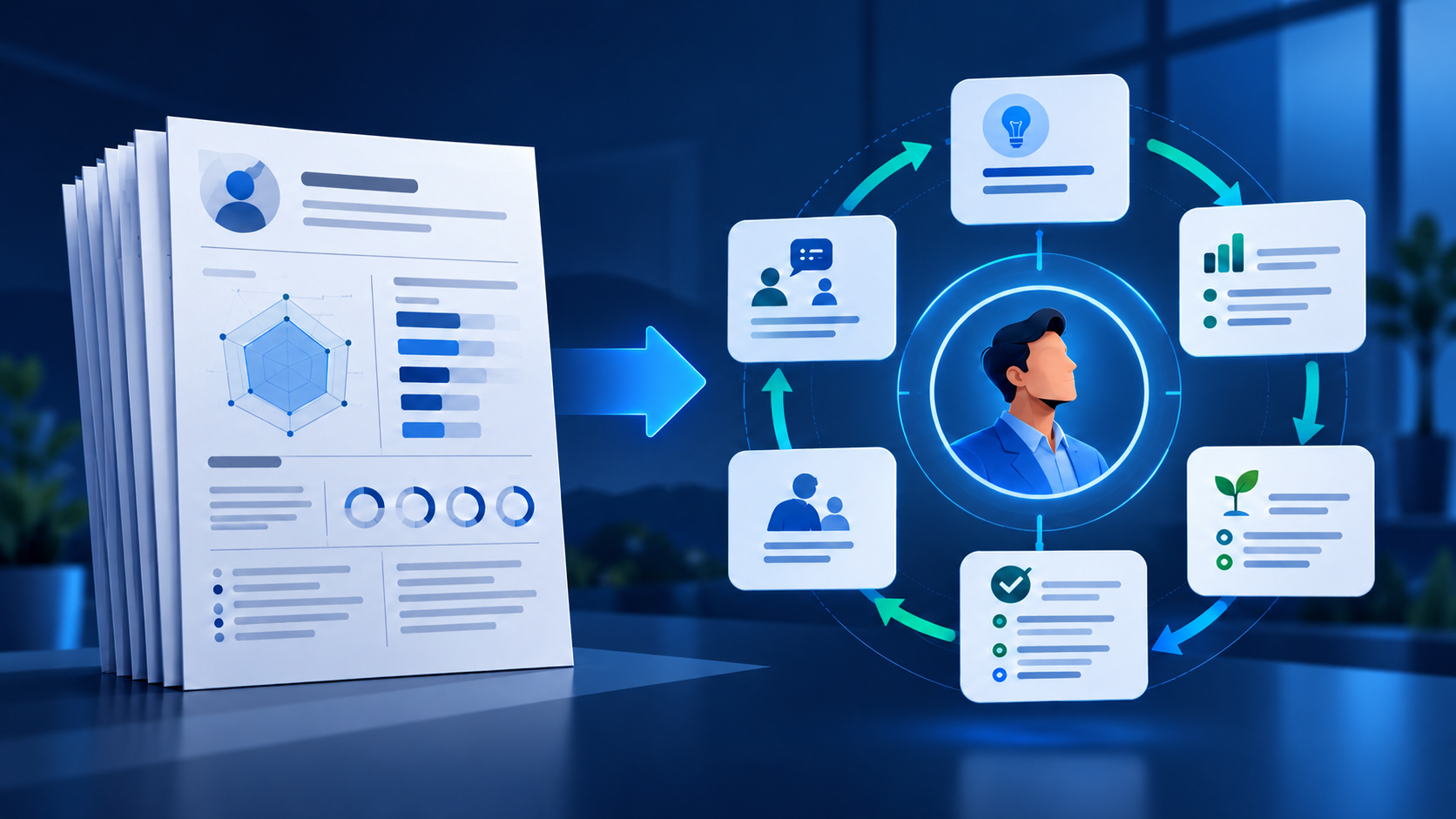
A more useful framing for 2026 is that succession readiness is dynamic. It changes as business strategy changes, as growth rate changes, as skill demands shift, and as people join, leave, move, develop, or narrow their career preferences. These rapid changes mean succession planning should be a living portfolio of leadership and business-critical role options. The human decision remains central. What changes is the information architecture around it.
This matters because several public signals now point in the same direction. The World Economic Forum reports that employers expect 39% of workers' core skills to change by 2030, which should immediately challenge any succession process that assumes role requirements are mostly stable.[1] OECD analysis points to demographic pressure, declining working-age populations in many OECD countries, and the need to retain and reskill older workers, all of which raise the cost of weak internal bench planning.[2] CIPD now describes succession planning less as a narrow top-down exercise and more as part of a broader, future-focused workforce and talent system.[3][4] At the same time, DDI's 2025 HR research suggests only about half of critical business leadership roles could be filled immediately by internal candidates, while Heidrick's 2025 succession research shows many boards remain reactive rather than continuous in how they manage leadership pipelines.[5][6][7]
In other words, the problem is not a lack of interest in succession. It is a mismatch between the speed of organizational change and the update cycle of the process.
The implication for leaders is straightforward: the next generation of succession planning should behave less like a static snapshot and more like a continuously refreshed risk-and-readiness system.
Why the old model breaks faster now
Traditional succession planning was built for a more stable operating environment. CIPD notes that large organizations historically ran highly structured, confidential, top-down succession schemes aimed at identifying internal successors for key posts and planning their paths accordingly. It also notes that this style has declined amid uncertainty, faster change, and flatter structures, and that modern succession planning now tends to be broader, more open, and more tightly linked to wider talent management practices.[3]
That shift is not cosmetic. It reflects a deeper change in what readiness actually means.
In practice, readiness has never been a fixed trait. It has always depended on role requirements, business context, timing, support, and development opportunity. What has changed is that these variables now move fast enough that a once-a-year or twice-a-year update cycle leaves material blind spots. A role that looked like an operational continuity job may become a transformation role. A regional leadership position may suddenly require stronger data fluency, regulatory sophistication, or AI adoption judgment than it did six months earlier. A successor pool designed around yesterday's role architecture can therefore look 'complete' on paper while being underpowered in reality.
The skills backdrop matters here. The World Economic Forum's 2025 Future of Jobs work does not suggest slow, marginal skill drift. It suggests sustained disruption at a high level.[1] The demographic backdrop matters too. OECD analysis shows that population ageing is reshaping labor markets, that employment declines rapidly after age 60, and that retaining and developing experienced workers is becoming economically important.[2] The business backdrop matters as well. The Conference Board reports that CEO turnover accelerated among large companies in 2025, while Heidrick's research describes a business climate where sustained disruption and stakeholder scrutiny are pushing boards to treat leadership readiness as material to performance.[7][6]
The result is a common failure mode: organizations maintain a nominal succession list, but the list is too thin, too role-specific, too senior-only, or too disconnected from actual workforce movement to function as a durable continuity mechanism.
A second failure mode is concentration risk.
Many succession plans depend on a handful of familiar high-potential names to support multiple critical roles. This often feels efficient, especially in organizations that pride themselves on a small elite bench. In practice, it creates fragility. If the same two or three candidates sit behind too many roles, the organization has not reduced risk; it has concentrated it. One exit, one decline in readiness, or one change in personal mobility preference can create cascading exposure across multiple business-critical positions.
A third failure mode is false precision.
Organizations often speak about readiness as though it were a stable, objective state rather than a judgment supported by evidence of varying quality. That encourages overconfidence. It also creates poor development follow-through. A more credible approach is to treat readiness as a time-bound estimate with confidence levels, known evidence gaps, and explicit development conditions.
This is where the old succession document runs out of useful room. It is built to present answers. What the organization increasingly needs is a system that can keep asking the right questions as reality changes.
From named successors to a living portfolio
A living succession portfolio is not merely a more frequently updated list. It is a different operating model.
At minimum, it includes five things.
First, it defines critical roles with more discipline. That sounds obvious, but many succession processes are imprecise about what is truly business-critical, what level of disruption a vacancy would create, and
what capabilities matter most for each role over the next 12 to 36 months. Without that foundation, portfolio quality cannot improve because the target is unstable.
Second, it uses pools where appropriate rather than forcing every role into a one-to-one replacement logic. CIPD explicitly notes a growing focus on groups of roles and on developing pools of adaptable talent capable of filling a variety of positions.[3] That is a more resilient design for 2026 because many organizations do not need a single pre-selected heir for each role; they need multiple credible options across role families, geographies, and development horizons.
Third, it treats readiness as a moving estimate. Instead of a single label, the portfolio should track at least: likely readiness horizon, confidence in that judgment, freshness of underlying evidence, relevant development gaps, placement risks and constraints such as mobility, aspiration, or retention risk. That creates a more honest picture of bench strength and reduces the temptation to speak about potential as though it were fixed inventory sitting in storage.
Fourth, it makes concentration visible. A living portfolio should show whether the same candidates appear in too many slates, whether specific functions or regions are chronically underrepresented, and whether the organization is repeatedly relying on a narrow feeder pattern for leadership continuity. This is particularly important when the business says it wants agility but the talent architecture still assumes a small set of conventional career paths.
Fifth, it links succession to workforce planning rather than isolating it as a Board- or HR-driven process. CIPD describes workforce planning as a core business process that balances labor supply and demand, identifies gaps, and translates them into action, while also emphasizing that the process is iterative, dynamic, and subject to constant feedback and review.[4] That is exactly the mindset succession planning now requires. Succession is not a decorative appendix to workforce planning. It is one of its consequence-bearing use cases.
This portfolio framing also solves a subtle but important problem. It shifts the goal from 'proving that we have a plan' to 'maintaining optionality under changing conditions.' That is a healthier objective because optionality is what organizations actually need when leadership transitions happen under pressure.
Where AI can help without taking over the decision
The common mistake in people-adjacent AI adoption is to jump too quickly from information support to judgment automation.
Succession planning is a poor candidate for that mistake. Employment-related AI systems can materially affect promotion, evaluation, and career prospects. The EU AI Act explicitly classifies AI systems used in employment, worker management, promotion, termination, task allocation, and performance evaluation as high-risk because of their impact on livelihoods and workers' rights.[8] At the same time, the same legal framework draws a meaningful distinction for systems that perform preparatory tasks or narrow procedural support without materially influencing the outcome of the decision.[8] That distinction is highly relevant here.
It suggests a practical design principle: use AI to improve continuity, interpretation, and preparation, not to substitute for accountable human judgment.
In practice, AI can add value in six areas.
1. Evidence assembly and normalization
Succession evidence is usually scattered. Role histories, assessment reports, manager input, career preferences, development activity, mobility constraints, experience data, and performance context often sit across different systems and documents. AI can help unify and normalize this information into structured candidate and role summaries.
That does not mean indiscriminate data ingestion. It means a governed approach to pulling from agreed sources, showing provenance, and standardizing language so that decision makers compare like with like. A large share of the current friction in succession work is not deep judgment; it is information fragmentation.
2. Event-driven refresh
A static plan ages because the world moves between review cycles. AI can monitor predefined triggers and flag when a succession profile should be refreshed: a critical role holder exits, a candidate changes role, a major project expands someone's scope, a development milestone is completed, a secondment ends, a retention indicator changes, or a new business capability becomes strategically important.
Deloitte's 2026 Human Capital Trends work is useful here. It argues that the cycle of planning, locking in resources, and execution can no longer keep pace with reality, and notes that only 20% of leaders say they are currently using AI to monitor signals of workforce changes, even though 52% believe doing so will matter to their success over the next three years.[9][10] Succession planning is an obvious candidate for this kind of signal-based refresh model.
3. Broadening the pool beyond obvious incumbents
One of the most promising uses of AI is to make adjacent talent more legible. OECD work on skills-first approaches argues that skills-based practices can broaden the talent pool and improve access to opportunities for people who might be missed by traditional filters.[11] CIPD likewise emphasizes that talent management can take a broader, more inclusive view and that succession can operate through internal talent pools rather than narrow successor naming.[12][3]
For succession, that means AI can help identify candidates whose role titles do not make them immediately visible but whose skills, experiences, and development trajectory suggest plausible future fit. This does not replace human judgment about culture, timing, or consequence management. It improves the search field so that the human discussion starts with better options.
4. Scenario simulation
A living succession portfolio should be able to answer 'what if' questions quickly.
What if a key regional leader leaves within 90 days?
What if a new strategic capability suddenly becomes non-negotiable for the next CFO?
What if two near-ready candidates are both retention risks?
What if the organization chooses to split a role rather than replace it directly?
Deloitte describes digital twins as live, AI-powered models of organizations and workforces that can be used to simulate decisions and predict needs.[10] Only a small minority of organizations are using them today, but the concept matters even if a company does not use the label. The core idea is that workforce decisions should be stress-tested against scenarios instead of being evaluated only in the calm conditions of annual planning cycles.
5. Risk analytics
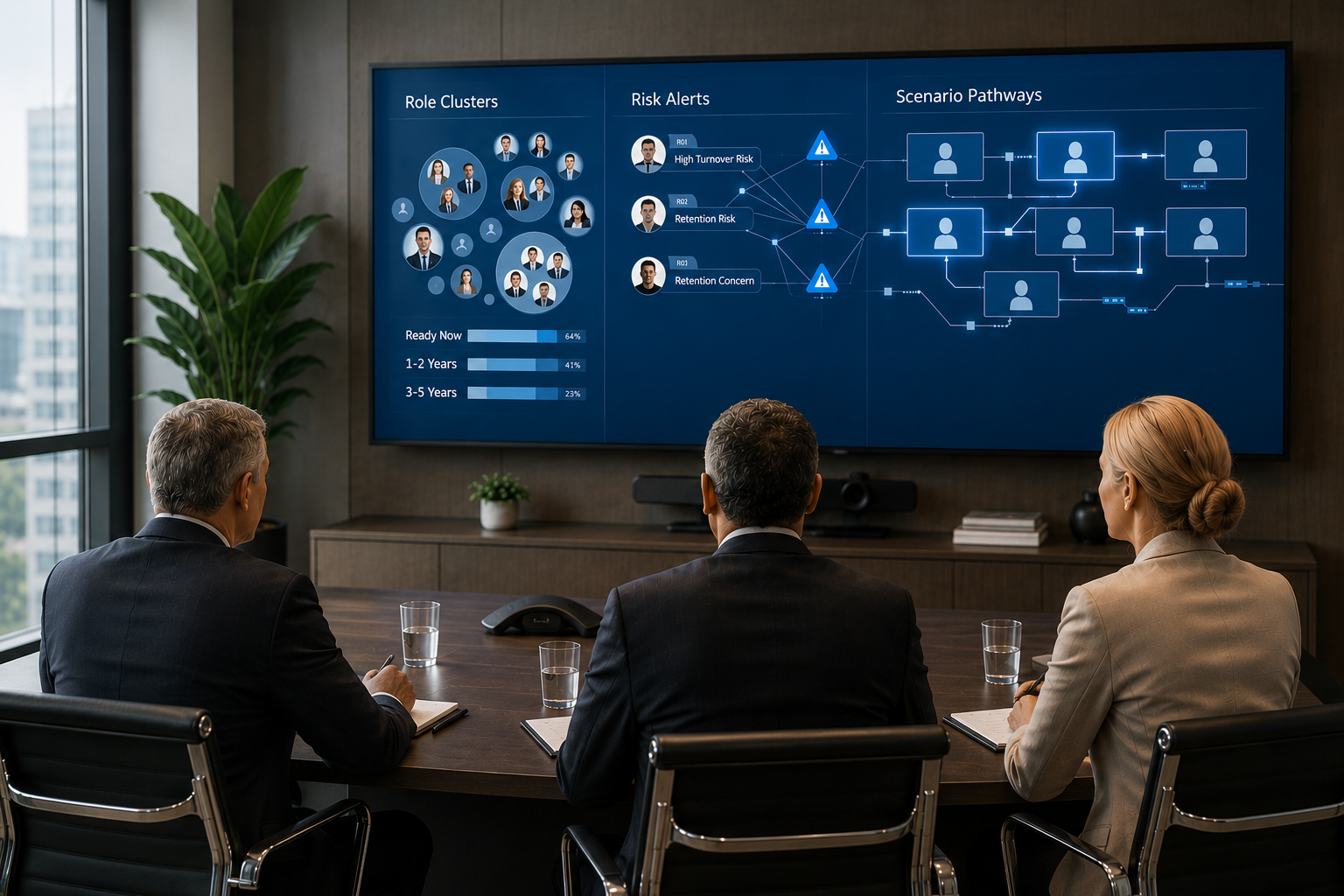
A dynamic portfolio can produce decision-grade analytics rather than presentation-only summaries. That includes bench depth, concentration risk, readiness velocity, evidence freshness, internal versus external fallback dependency, and coverage gaps by business unit or geography.
This is not about creating a single magic score. It is about making risk visible earlier. DDI's 2025 HR findings underscore how thin many leadership pipelines remain.[5] The useful move is to convert succession from a periodic opinion exchange into a monitored operating risk with named indicators.
6. Portfolio planning
AI can also enable portfolio planning, including assessing candidate fit against job requirements, comparing candidates against future capability requirements, and summarizing development progress. For example, AI can efficiently identify the risks of placing leaders from a talent pool into a variety of target roles. This can highlight role fit, placement risks, how to mitigate those risks, and how best to develop leaders to overcome them.
Importantly, AI is used to prepare for succession or portfolio planning discussions without deciding the outcome. AI acts as an assistant to identify changing success profiles, map leader capabilities to target roles, identify possible risks, and suggest development alternatives. The accountable human still interprets, challenges, calibrates, and decides.
AI can improve the quality of succession meetings without deciding the outcome. It can draft candidate briefs, identify missing evidence, flag outdated assessments, compare candidate slates against future capability requirements, summarize development progress, and record decision rationales for future auditability.
That last point matters more than it seems. One of the recurring weaknesses in succession planning is institutional memory loss. Decisions are made, but rationale is poorly documented. Months later, no one can explain why one person was judged near-ready and another was not, or what evidence would have justified a different conclusion. AI can help preserve continuity in the decision process itself.
The key distinction is that these are assistance tasks. The accountable human still interprets, challenges, calibrates, and decides.
What a better succession analytics layer should measure
Organizations do not need a universal formula. They do need a better operating dashboard than a red-amber-green slate.
A practical succession analytics layer should answer the following questions on a recurring basis:
Coverage: Which critical roles have at least two or three credible successors, and which rely on a single candidate or none at all?
Concentration: Where are the same people carrying too much portfolio weight across multiple roles or regions?
Readiness horizon: How many successors are genuinely ready now, ready soon, or still emerging, and how confident is the organization in those judgments?
Freshness: How recently was the underlying evidence updated? A profile untouched for nine months should not be treated as current.
Readiness velocity: Are near-ready candidates actually progressing toward readiness, or simply remaining on lists?
Diversity and inclusion: Is the organization broadening opportunity, or reproducing a narrow internal pattern of visibility and sponsorship?
Scenario resilience: How does the portfolio hold up under plausible shocks such as sudden exit, restructuring, rapid expansion, or skills redefinition?
Development linkage: Are succession insights actually driving tailored experiences, secondments, coaching, or role moves, or are they stopping at classification?
None of these metrics should be treated as self-sufficient truth. They are signals for human interpretation. But together they are far more useful than the common alternative, which is a well-designed slide that obscures fragility.
For leaders, the implication is not to build a bigger dashboard for its own sake. It is to move the succession conversation from 'who do we like?' toward 'where are we exposed, where are we overconfident, and what evidence-backed options do we actually have?'
Governance: the basis of trust must sit outside the model
The quality of the AI model is not the main governance issue here. Workflow design is.
NIST's AI Risk Management Framework emphasizes that AI risk management should be continuous, timely, and carried out across the lifecycle, with governance as a cross-cutting function.[13] NIST's Generative AI Profile also highlights the need for accountable executives to oversee AI system adoption, use, and decommissioning, not merely approve a tool purchase.[14] Those principles translate cleanly into succession planning.
A responsible design for AI-supported succession work should therefore include:
clear decision rights for HR, business leaders, and committees;
explicit source systems and rules for what data is in or out of scope;
evidence provenance for every important summary or recommendation;
documented limits on automated ranking or predictive claims;
bias, fairness, and impact testing where appropriate;
logging of significant interactions, changes, and overrides;
training for reviewers so that 'human in the loop' means competent review, not ceremonial sign-off.
The EU AI Act provides another useful signal. It does not merely say 'have human oversight.' It also requires technical measures that help deployers interpret outputs appropriately.[8] That is an operational reminder that oversight depends on intelligibility. If a succession system cannot explain what signals surfaced a candidate, what assumptions shaped a readiness view, or what evidence is missing, then the human reviewer is not genuinely overseeing anything.
There is also a practical cultural issue. Organizations should resist the temptation to turn AI into a way of hiding disagreement behind computational authority. Succession planning has always involved judgment, uncertainty, and politics. Good governance does not eliminate that reality. It makes the evidence stronger, the limits clearer, and the responsibility harder to evade.
A reasonable prediction for the next phase
A bounded prediction for 2026 and the following few years is that leading organizations will start moving succession planning toward a live service layer rather than an annual or semiannual deck cycle.
That service layer will not necessarily be branded as a 'digital twin' or 'talent operating system.' In many organizations it will emerge more quietly. The underlying pattern, however, is likely to be consistent:
critical roles will be mapped more explicitly to future capability needs;
successor pools will be maintained at the level of role families, not just named posts;
AI will monitor agreed signals and trigger refreshes when the portfolio changes;
committees will review a more current, scenario-ready view of risk and readiness;
development actions will be tied more directly to bench gaps;
final promotion and succession decisions will remain human-owned.
The organizations that benefit most will not necessarily be the ones with the most advanced models. They will be the ones with cleaner role architecture, better workforce data discipline, clearer governance, and more mature decision routines.
That is an important distinction because it keeps the adoption agenda sober. Succession planning does not need a theatrical AI layer. It needs a reliable information and workflow layer that reduces staleness, broadens viable options, and makes risk legible early enough to act.
What leaders should do now
The immediate leadership move is not to ask whether AI can 'do succession planning.'
The better question is whether the organization is prepared to redesign succession as a dynamic workflow.
A practical response is to start with one level below the rhetoric:
Define the genuinely critical roles and the future capabilities that matter most for each.
Shift from one-name-per-role thinking toward pools, role families, and optionality.
Establish a minimum evidence model for readiness, including freshness and confidence.
Use AI first for assembly, refresh, scenario preparation, and risk visibility.
Link development actions more directly with bench gaps.
Keep consequence-bearing judgment with accountable humans, with clear oversight and documentation.
Review the portfolio on an operating rhythm, not just in calendar rituals.
Succession planning will remain a human decision for the foreseeable future, and it should. But the information environment surrounding that decision does not need to remain static, fragmented, and late.
The organizations that improve most over the next few years are unlikely to be the ones that automate the judgment. They are more likely to be the ones that stop treating succession as a document and start treating it as a live portfolio of organizational resilience.
About the Authors
Eloi Tay
Eloi Tay leads product, technology, and operations for Organisation Solutions Pte Ltd. He is a computer scientist focused on software development, AI, and automation that help organizations scale growth and operating efficiency. He is based in Singapore.
James Eyring, PhD
Dr. James Eyring is Chief Executive Officer of Organisation Solutions, a global leadership and team assessment, coaching, and development firm. James has led Organisation Solutions' global coaching and assessment practice since 2007, and became CEO in 2021. Based in Asia for 25 years, he brings a deep, first-hand understanding of leadership across global and emerging markets to his work with executives and their teams.
With a PhD in Industrial/Organizational Psychology and over 30 years of experience assessing, coaching, and developing executives and their teams, James is an active researcher and thought leader on leadership, growth capabilities, and potential. He has taught undergraduate and graduate-level courses and published widely in academic and practitioner outlets — most recently authoring book chapters on Strategic Workforce Planning and Innovations in Assessment in SIOP's Professional Practice Series.
About Organisation Solutions
Organisation Solutions enables smarter growth and transformation in ambitious businesses. Visit our website to learn more about our assessment, coaching, and leadership development services; explore the Growth Leader Assessment Suite; or join an upcoming LEA.Lab to see a live demo of how AI Agents can partner with talent professionals for Dynamic Succession. Website: organisationsolutions.com
Notes and sources
1. World Economic Forum, 'The Future of Jobs Report 2025,' especially the Skills Outlook section, published 7 January 2025. https://www.weforum.org/publications/the-future-of-jobs-report-2025/in-full/3-skills-outlook/
2. OECD, 'OECD Employment Outlook 2025,' published 9 July 2025, especially the overview and ageing-related chapters. https://www.oecd.org/en/publications/oecd-employment-outlook-2025_194a947b-en/full-report.html
3. CIPD, 'Succession planning,' Factsheet, updated 5 December 2025. https://www.cipd.org/en/knowledge/factsheets/succession-planning-factsheet/
4. CIPD, 'Workforce planning,' Factsheet, updated 29 July 2025. https://www.cipd.org/en/knowledge/factsheets/workforce-planning-factsheet/
5. DDI, 'New DDI Research Reveals Only 20% of CHROs Have Leaders Ready to Fill Critical Business Roles,' published 25 June 2025. https://www.ddi.com/about/media/hr-insights-report-2025
6. Heidrick & Struggles, 'Route to the Top 2025 | The ascent redefined: Charting more effective routes to the summit,' published 23 July 2025. https://www.heidrick.com/en/insights/chief-executive-officer/route-to-the-top-2025-the-ascent-redefined
7. The Conference Board, 'Report: CEO Departures Are Rising, Even at Strong-Performing Companies,' published 24 November 2025. https://www.conference-board.org/press/ceo-succession-2025
8. European Commission, 'Navigating the AI Act' FAQ, and Regulation (EU) 2024/1689, especially Article 6 and Recital 53, on high-risk AI systems and limited-risk exemptions for narrow procedural or preparatory tasks. https://digital-strategy.ec.europa.eu/en/faqs/navigating-ai-act and https://eur-lex.europa.eu/eli/reg/2024/1689/oj/eng
9. Deloitte, '2026 Global Human Capital Trends,' published 4 March 2026. https://www.deloitte.com/us/en/insights/topics/talent/human-capital-trends.html
10. Deloitte, 'Orchestrating for agility,' 2026 Human Capital Trends, published 4 March 2026. https://www.deloitte.com/us/en/insights/topics/talent/human-capital-trends/2026/orchestrating-for-agility.html
11. OECD, 'Empowering the Workforce in the Context of a Skills-First Approach,' published 24 June 2025. https://www.oecd.org/en/publications/empowering-the-workforce-in-the-context-of-a-skills-first-approach_345b6528-en/full-report.html
12. CIPD, 'Talent management,' Factsheet, updated 26 November 2025. https://www.cipd.org/en/knowledge/factsheets/talent-factsheet/
13. NIST, 'Artificial Intelligence Risk Management Framework (AI RMF 1.0),' NIST AI 100-1. https://nvlpubs.nist.gov/nistpubs/ai/nist.ai.100-1.pdf
14. NIST, 'Artificial Intelligence Risk Management Framework: Generative Artificial Intelligence Profile,' NIST AI 600-1. https://nvlpubs.nist.gov/nistpubs/ai/NIST.AI.600-1.pdf
Follow Us
Latest Insights