
The High Cost of the Static 360
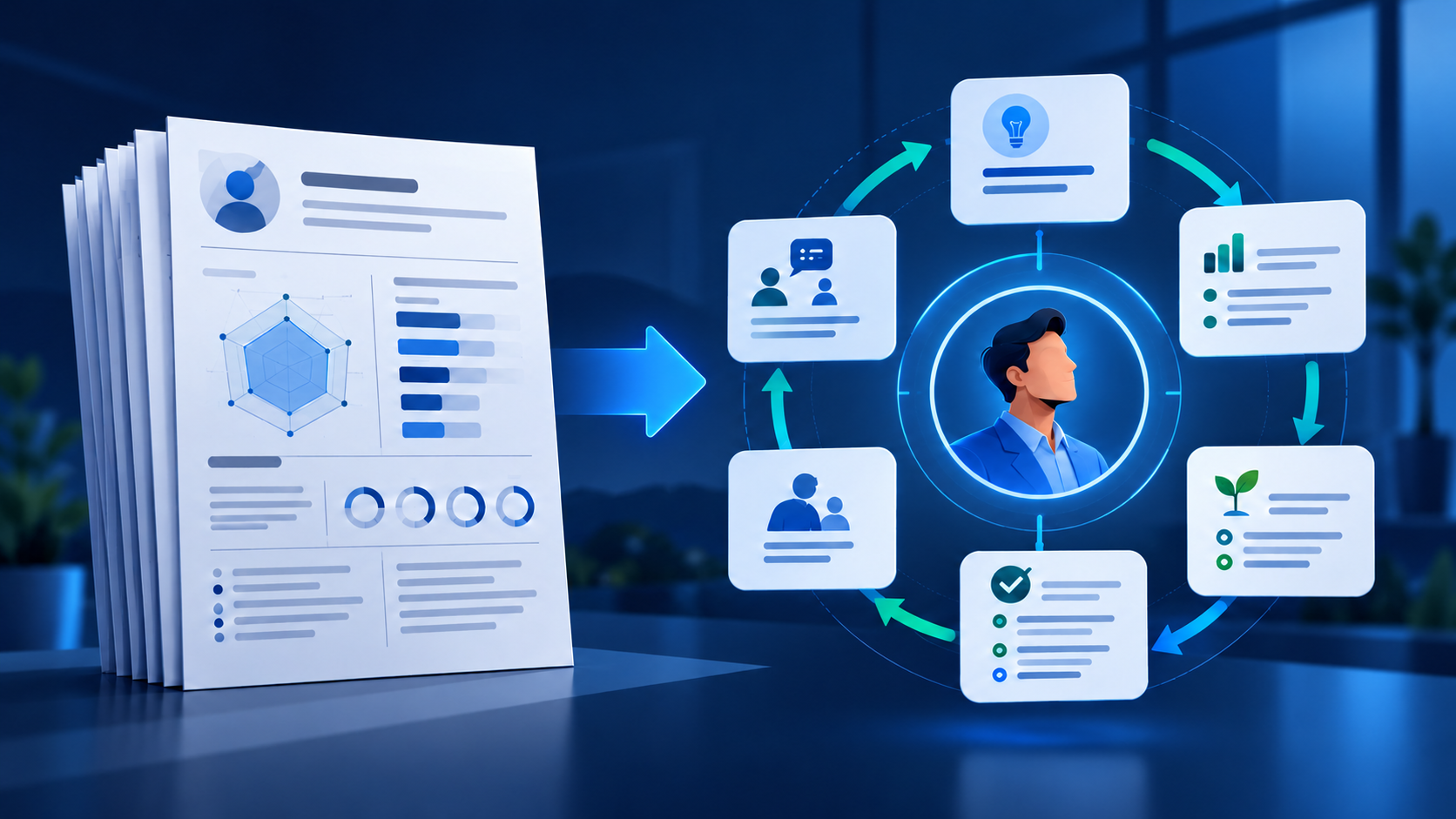
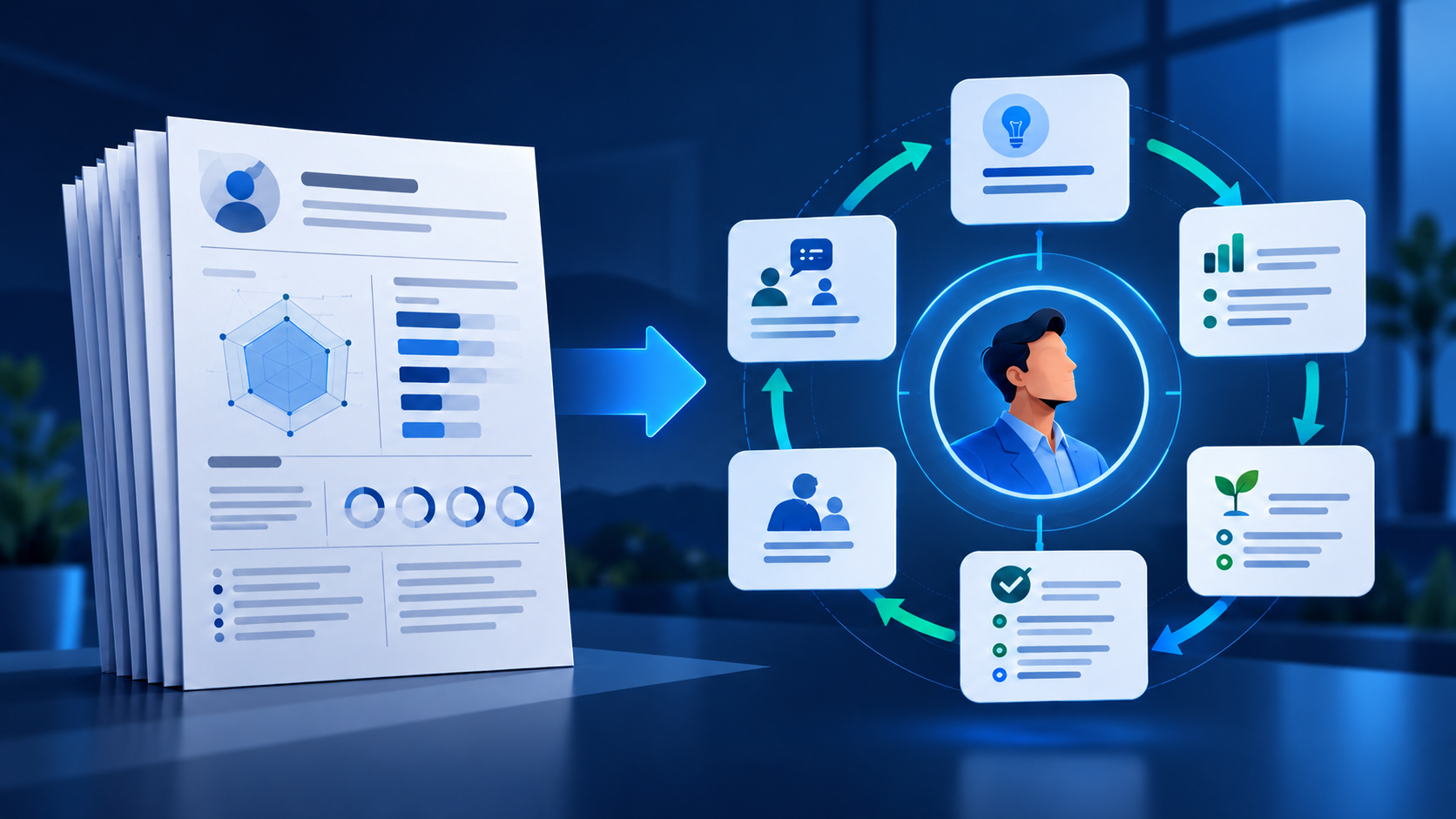
Organizations spend millions on 360-degree assessments that generate plenty of data and very little behavior change. The model itself needs to change, not just the delivery.
In a business landscape defined by constant transformation, the 360-degree assessment has barely moved. Companies spend heavily on 360 vendors, tools, processes, and feedback sessions. In return, they get a stack of ratings, a handful of stakeholder comments, and a leader who gains some insight through a one-hour conversation and then goes back to leading exactly as before.
The research is not encouraging. Traditional 360 ratings full of stakeholder bias and rating errors1, have no or a very small impact on behavioral change2, and can negatively impact leader engagement and productivity2. The gap between the money and time spent and the behavior changed is the real cost of today’s 360. There is a significant opportunity cost of a leadership development tool that generates insight but not outcomes.
Over the past decade, vendors have answered these issues with new technology, including scalable surveys, dashboards, and polished portals. It's now faster to administer and create a 40- to 60-page report. However, scaling a flawed process doesn't fix the flaw. It just delivers the same results to more leaders, faster.
At Organisation Solutions, we’ve spent more than 25 years helping organizations build leaders who drive growth and transformation. What we’ve learned is that the philosophy of the instrument itself need to change, from retrospective judgment to future-focused action. That shift is the difference between a 360 that produces a report and a 360 that produces a better leader.
The Three Fatal Flaws of Today’s 360s
Most 360s fail leaders because they measure the wrong things, in the wrong way, with the wrong focus. To accelerate development, increase leader impact, and drive company growth, three design flaws must be addressed:
1. The Outcome Gap
Many large organizations have customized their 360s to company competencies or role levels, yet most still miss the drivers of company growth. The first challenge is in what gets measured. Companies measure competencies such as courage or creativity, but pay little attention to capabilities that drive growth, such as leading teams to innovate or shaping an external focus on the market.
The second problem is how it gets measured. Most 360s measure how often a behavior occurs, and some measure whether it occurs too much or too little. Knowing how often a leader invites others to share their views is useful. It doesn’t tell you whether that leader has strong, trusting, collaborative relationships with stakeholders.
2. The Threat to Self
A traditional 360 report is backward-looking and evaluative by design. It tells leaders what they did, how it was perceived, and how they compare to others. Most leaders experience this combination as threatening, which triggers defensiveness rather than openness.
When threatened, leaders ask for more specific examples, blame the results on one or two stakeholders, or dismiss the 360 as “just perceptions.” Even when leaders may ultimately accept the feedback, they often don’t know how to address the feedback or aren’t motivated to act.
3. The Disposition Dead-End
Some 360s have tried to solve these problems by measuring personality traits, beliefs or motivations. Leaders learn that they are low on composure or high on arrogance. In addition to triggering a psychological threat, these traits are slow and difficult to change. A leader told they are “not naturally decisive” has been given a label, not a lever. Dispositions can shift but only with significant and sustained effort. Most organizations don’t have that kind of time.
The Blueprint for Innovation: Shifting from Judgment to Evolution
Fixing these flaws isn’t a matter of better technology or a friendlier report template. At OS, we rebuilt the instrument around three ideas: Define success specifically, orient input toward the future, and target behavior instead of personality.
1. From Scoring to Striving: The 100% Definition
Instead of measuring how often a behavior occurs, we define what ideal outcomes look like at a given leadership level and measure the leader against that standard. The capabilities we target are the ones that drive important organizational outcomes, including growth and transformation.
The definitions for each capability draw on positive psychology and goal theory. The question shifts from “How often does this person exhibit this behavior?” to “How close is this person to the outcomes a leader at this level should achieve?” That provides leaders a clear, aspirational target that leaders can strive to achieve. It also eases the cultural problems built into traditional rating scales.³
To reflect the outcomes expected of leaders at different levels, 100% Definitions are created for individual contributors, people managers, mid-level managers, function and business-unit leaders, and CEOs. Stakeholders rate the leader against the 100% definition and indicate how important this capability is for the leader’s role. If stakeholders rate a leader at 65% on a highly important capability, the leader knows exactly where to focus.
2. From Feedback to Feed-Forward
A traditional 360 asks stakeholders for feedback. Some newer 360s ask what the leader should start, stop or continue doing, which often becomes a list of corrections for past mistakes.
Feed-forward asks stakeholders to act as future-focused development allies. When a leader shows a large gap to the 100% Definition, stakeholders suggest one action the leader can take to close it. That single change in the question produces practical, forward-looking advice and removes most of the threat from the exercise. Stakeholders aren’t judging the past; they’re investing in the leader’s future, and leaders feel the difference the moment they read their report.
3. From Characteristics to Behavioral Risk
Instead of measuring negative dispositions, or the over- or under-use of behaviors, we measure the risk that a leader will show behaviors that reduce their effectiveness or damage results. Stakeholders rate how likely the leader is to show these behaviors under stress. For example, a leader may be at high risk of setting goals that are too easy, failing to step in and lead, or not championing new ideas.
A leader receiving this risk rating knows they may need to step forward and drive change or results with more urgency. It isn’t about who they are. It’s about the impact their behavior has on results, especially under pressure, and it points to everyday actions that increase their impact.
The Results: Leaders Welcome the 360 and Improve Most Where They Need It
We've seen this combination work. In a leadership program we designed for a global life-sciences R&D organization, about 30 senior leaders completed a custom 360 built around key growth capabilities, our 100% Definition approach and feed-forward.
All five leadership capabilities improved from the pre-program to the post-program assessment.
58% of leaders improved by more than five points in at least one capability.
Leaders who started below the 80% threshold on a capability gained an average of 5.7 points, while leaders already above it showed essentially no change.
94% of leaders named personal insight as the program’s single most valuable element, and almost all of it traced back to the 360.
The pattern matters. A feed-forward 360 does its best work exactly where the traditional model does its worst: with the leaders who most need a concrete next step, not another score. Instead of feeling threatened by the 360, these leaders welcomed it.
The gains are even larger when the 360 is paired with coaching. Leaders increase their 360 capability scores by an average of 47% from their pre-coaching baseline to their post-coaching assessment.
Closing the Loop: Activating Insight into Continuous Action
Even a well-designed feed-forward 360 will have little impact if it remains a one-time event. Whether an organization uses our standard GL360 or a fully custom 360 like the one above, the data only grows in value once it leaves the static report.
The goal is to weave 360 data into the organization’s broader talent ecosystem. In LEA, OS’s AI-enabled talent platform, a leader’s 360 and behavioral risk profile can be combined with other assessment data, the leader’s goals, and their business challenges to produce a short 360 summary, a draft development plan, or a coaching guide for the manager. Instead of relying on a single 360 feedback conversation, LEA equips the leader and manager with guidance on development actions over the next quarter.
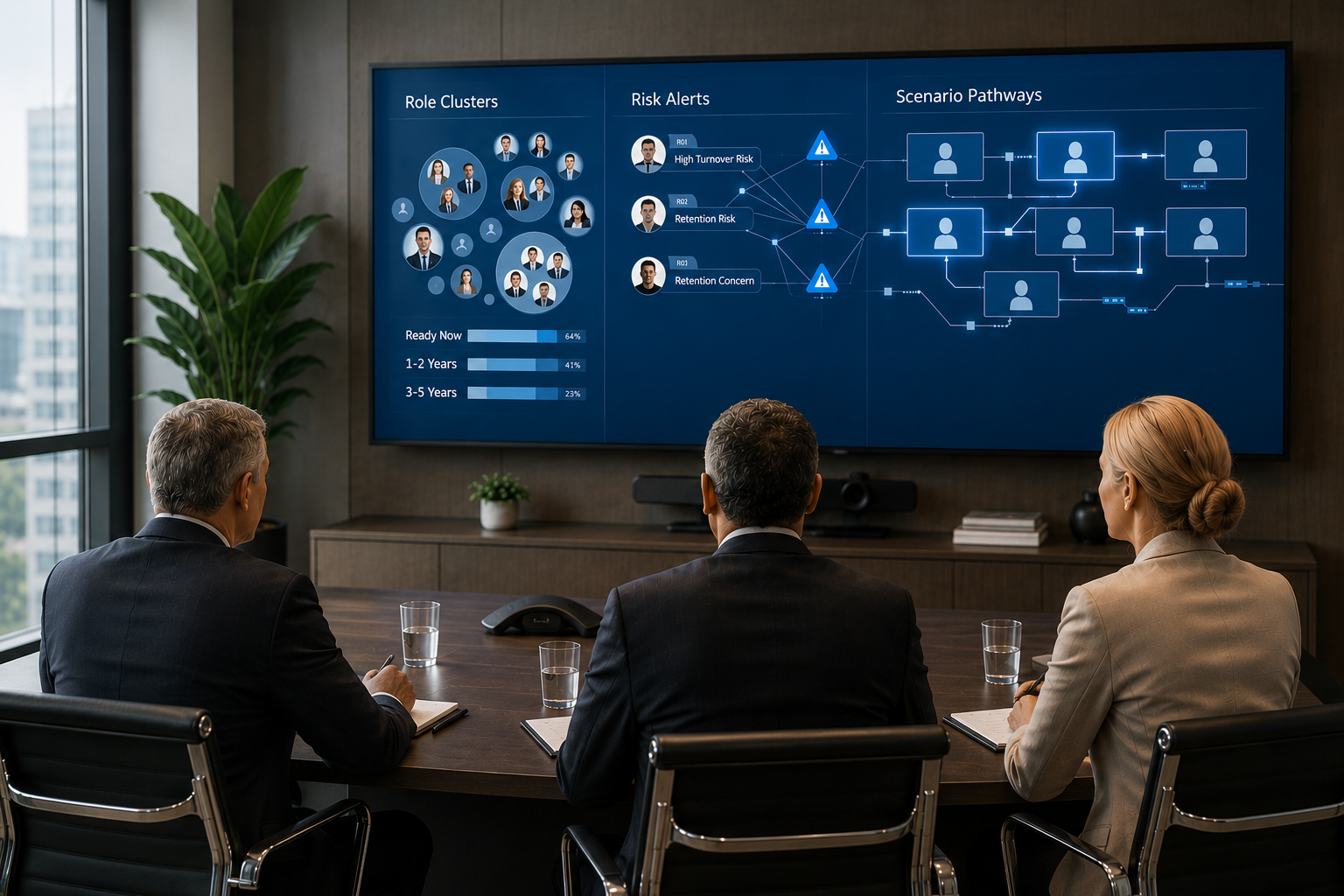
The same infrastructure pays off at the organizational level. Because every leader’s 100% Definition scores and risk profile share a common structure, HR and talent teams can roll individual results into group reporting without extra work. That view lets a single 360 program inform succession planning, gauge readiness for new roles and surface capability gaps across a whole layer of leadership. An individual development exercise becomes a source of organizational intelligence.
A Call to Action
The shift underneath all of this is a move from a culture of critique to a culture of capability. A traditional 360 tells leaders how they compare to other leaders. A feed-forward 360, built on role-specific standards, focused on observable behavior and connected to tools that turn insight into a plan, tells leaders what they can do to have greater impact in future and gives them the means to do it.
That difference isn’t cosmetic. It separates a development investment that produces a report from one that produces a better leader, and with it, better business results. If your organization still runs a traditional 360, the fix isn’t a better dashboard on the same instrument. It’s rebuilding the instrument around striving instead of scoring, feed-forward instead of feedback, and behavioral risk instead of personality.
Organizations that make this shift aren’t just running a better assessment. They’re building leadership development that moves the needle on growth and transformation, one leader, one behavior and one 100% Definition at a time.
See what a feed-forward 360 looks like here. Download a sample GL360 report to see 100% Definition ratings, feed-forward actions from stakeholders and a behavioral risk profile, laid out the way a leader receives them.
References
Scullen, S. E., Mount, M. K., & Goff, M. (2000). Understanding the latent structure of job performance ratings. Journal of Applied Psychology, 85(6), 956.
Nowack, K. M., & Mashihi, S. (2012). Evidence-based answers to 15 questions about leveraging 360-degree feedback. Consulting Psychology Journal: Practice and Research, 64(3), 157.
Holt, K., & Seki, K. (2012). Global leadership: A developmental shift for everyone. Industrial and Organizational Psychology: Perspectives on Science and Practice, 5, 198–217.
About the Author
James Eyring, PhD, is CEO and Chief Science Officer of Organisation Solutions, where he leads a global practice of more than 300 coaches, assessors and leadership development professionals across five continents. An industrial-organizational psychologist with more than 30 years of global experience, he works at the intersection of business growth, transformation and leadership.
For more than 15 years, James has led research and development for OS’s Growth Leader Assessment Suite (GLAS), and he leads the certification of talent professionals in using it for selection, leader and team development, succession planning and workforce strategy. Before joining OS, he led HR and talent teams at Pizza Hut, Dell and Ingram Micro, where he headed HR for Asia Pacific. As an executive coach, he has worked with thousands of executives on every continent.
James holds a PhD and MA in industrial and organizational psychology. He has contributed to the Journal of Applied Psychology, the OD Review, HRPS and SIOP’s Professional Practice Series, and has written book chapters on strategic workforce planning, workforce planning for high-growth markets, innovations in assessment and global leadership. After 25 years in Singapore, he now lives in New York City and Washington, D.C.
About Organisation Solutions
Growth is hard work. We make it easier. Organisation Solutions combines deep expertise in high-growth markets with world-class solutions and capabilities. Founded in Singapore in 2000, OS has a global network of more than 300 coaches, assessors and leadership development professionals across five continents, helping organizations achieve and sustain growth wherever they do business. Our Growth Leader Assessment Suite (GLAS), including GL360, and Talent Studio, our AI-enabled talent platform, help organizations build the leaders and teams that growth demands.
Follow Us
Latest Insights